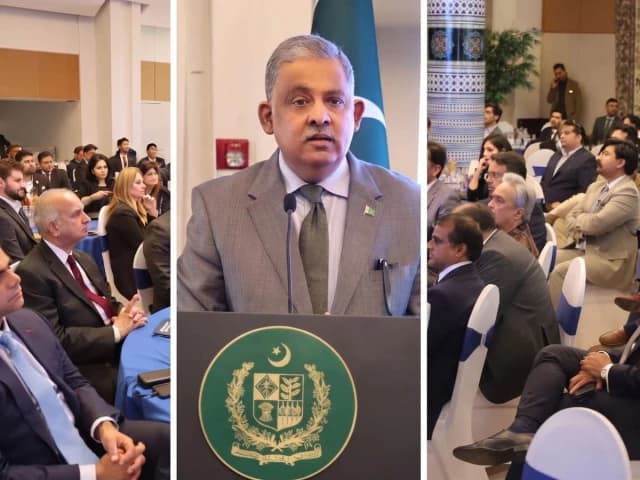
Austin AI founder Amir Husain says the numbers make him 'incredibly long Pakistan'

Amir Husain left Pakistan on 10 August 1996, when the KSE Index sat near 1,200 points. Three decades later, the Austin-based founder of SparkCognition - the AI company now called Avathon, which reached a unicorn valuation under his leadership - says the KSE-100 could cross 200,000 in the near future, and that adjusted for the rupee's fall and measured against the S&P 500 with dividends, the Pakistani market has met or exceeded the US index depending on the day you measure.
That is the first of three pillars behind his verdict, delivered in an interview: "I am incredibly long Pakistan." The second is energy. Husain said around 25% of Pakistan's electricity last year came from solar, making the country, outside Europe as a whole, the second largest importer of Chinese panels. The third is industry, with about 30 companies assembling vehicles in Pakistan, aviation exports under way and batteries next. None of it, he argued, depends on who is in government: "These are all things that are happening organically."
His most concrete recommendation concerns the country's gross domestic product figures. Husain put GDP at $420-$430 billion and suggested the undocumented economy runs from 45% to 80% of that, which would put Pakistan at a $750-$900 billion economy on a median estimate. The stakes are practical: some investment funds have minimum economy-size rules, so "with the correct numbers, Pakistan qualifies for inbound foreign capital that you would otherwise not qualify for." He said his figures drew on the World Bank, the finance minister and a Turkish academic study of household spending.
Husain, recently appointed to LUMS's University Advisory Board and to the first Industrial Advisory Board of the Asian American Academy of Sciences and Engineering, rejected the brain-drain framing outright. "Your brain is contributing to Pakistan right now as we speak," he said, speaking himself from outside the country. What must change is that capital flows: Pakistanis abroad should invest at home on merit, as Indians abroad have. He described himself as an investor in Pakistan's bonds, calling them "the best bond on the market, in my opinion" - a view he attributed to returns rather than sentiment.
For founders, his advice is to build for a customer who pays in dollars from day one, even if that customer is abroad, and to think global-first rather than replicating Uber or DoorDash locally. He said Pakistan's advantage is cost - it is cheap to reach a product-market fit conclusion - but that it needs products and brands, and that its large base of industrial equipment could be modernised with sensor and AI layers. On what he would commit to himself, he listed tests rather than plans: alignment of mission, the quality of the people and the scale of the economic impact. "More on this soon," he said of an AI research effort in Pakistan.